The Architecture of Business Communication and Networking
Effective business communication and networking are built upon intricate structures, both visible and invisible. Understanding these architectures is crucial for optimizing information flow and fostering a productive environment. We categorize these into formal and informal networks, each with distinct characteristics and impacts on commercial efficiency.
This infographic illustrates the key differences between formal and informal communication networks in a business setting.
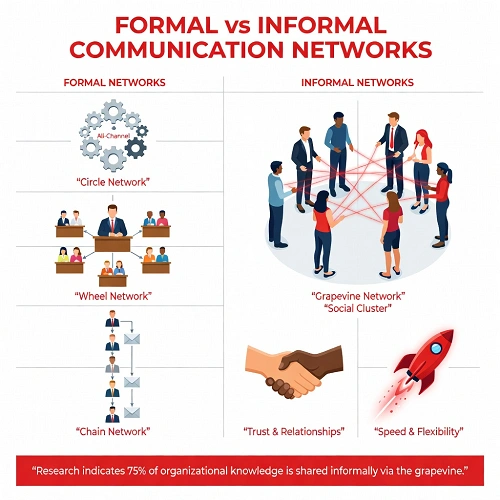
Formal networks are the official channels prescribed by an organization’s structure. They follow authority lines and are designed for structured information exchange, ensuring official protocols are met. Conversely, informal networks, often referred to as the “grapevine,” operate outside these official channels, driven by social affiliations and personal relationships. While formal channels handle critical directives and operational transparency, informal networks are surprisingly potent; studies suggest that an estimated 75 percent of all organizations’ practices, policies, and procedures are shared through grapevine communication. This highlights their significant role in shaping workplace culture and disseminating information, even if sometimes through less reliable means.
Formal Structures: Circle, Wheel, and Chain Networks
Within formal organizational structures, communication often adheres to specific patterns designed to maintain hierarchical flow and ensure clarity. These patterns dictate who communicates with whom and through which channels. Three common formal network structures are:
- Circle Network: In a circle network, communication flows sequentially, but each member can communicate with two adjacent members. For instance, in a meeting, person A might communicate with person B and person D. This structure allows for feedback and discussion among immediate peers, fostering a sense of participation, though it can be slower than more centralized models. It’s often seen in teams where equal input is valued.
- Wheel Network: The wheel network is highly centralized, with all communication flowing through a single central figure. This hub-and-spoke model is efficient for quick decision-making and clear directives from a leader to their direct reports. For example, a department head communicates directly with each team member, but team members communicate with each other only through the head. This ensures strong management communication and control but can limit horizontal collaboration.
- Chain Network: Similar to a hierarchical chain of command, the chain network involves communication flowing from one person to the next in a linear sequence. Information moves up or down the organizational ladder, ensuring that directives and reports follow established authority lines. This structure is common in traditional organizational hierarchies, promoting operational transparency by ensuring information passes through every relevant level.
These formal structures are essential for maintaining order, accountability, and the smooth execution of business processes. They define the official pathways for directives, reports, and official announcements, forming the backbone of an organization’s operational communication.
Informal Dynamics: Single Strand and Social Gatherings
Beyond the structured pathways, informal networks play a vital, albeit often unacknowledged, role in business communication. These “grapevine” channels are driven by social interactions and personal connections, often bypassing formal hierarchies entirely. They are powerful conduits for information, rumors, and social cohesion. Examples include:
- Single Strand Network: This is the simplest form of informal communication, where information passes sequentially from one person to another. It’s like a game of “telephone,” where urgent news might pass person-to-person through a series of individuals. While quick, the accuracy can degrade with each transmission.
- Gossip/Single-to-Clique Network: This network involves one person sharing information with a select group of others, often based on personal relationships or shared interests. A “clique” is a small group whose members typically do not welcome outsiders, and this network can spread information across multiple groups via overlapping members. For instance, a manager might share insights with a trusted inner circle, who then disseminate it further.
- Probability Network: In this network, information is shared randomly among individuals, often without a specific intention to spread it. It’s akin to casual conversations where tidbits of information are exchanged, and then those who hear it might pass it on to others they encounter.
- Cluster Network: This is the most common informal network, where one person shares information with a few trusted individuals, who then share it with their own trusted circles. This creates clusters of information dissemination, often seen in social gatherings or water-cooler talks where gossip and jokes exchanged during lunch breaks can spread rapidly.
These informal dynamics are crucial for building personal networks, fostering community engagement, and facilitating mutual exchange among colleagues. While they can sometimes lead to the spread of misinformation (the “rumor mill”), they also serve as vital channels for sharing organizational practices, building camaraderie, and providing emotional support, often filling gaps left by formal communication channels.
Strategic Principles for Professional Connectivity
Building and leveraging a robust professional network is less about chance encounters and more about strategic, principle-driven engagement. Just as a strong foundation supports a building, core principles underpin effective networking, ensuring reciprocity, synergy, trust, and credibility. Our approach emphasizes a helpful mindset, personal integrity, sustained effort, and maintaining life balance, all contributing to a strong professional brand equity.
At the heart of successful networking lies the principle of “give to receive.” Prioritizing helping others ahead of taking, often referred to as “Karma in business,” builds goodwill and fosters genuine connections. Maintaining personal integrity, admitting mistakes, and consistently following through on commitments are crucial for building trust. After all, people refer those they trust implicitly. Effective networking is not a scattered activity but requires sustained, focused effort. It’s also important to remember that a network without work produces nothing worthwhile. Balancing professional pursuits with personal well-being ensures you approach interactions with confidence and authenticity. For further insights into effective networking principles, we recommend exploring resources like the Business Fundamentals: Effective Networking course.
Crafting an Impactful Elevator Speech for Business Communication and Networking
One of the most fundamental tools in your networking arsenal is the elevator speech. This concise, compelling pitch is designed to introduce yourself, your business, your specialism, and your aims within a brief window, typically 10-20 seconds. Imagine meeting someone influential in an elevator at a conference; you have mere moments to make an impression.
An effective elevator speech should be:
- Concise and Clear: Get straight to the point. State your name, what you do, and what value you offer or what you’re looking for.
- Confident: Deliver it with conviction. Your tone and body language are as important as your words.
- Engaging: Make it memorable. Highlight what makes you or your business unique.
- Conclude with a Question: End with an open-ended question to invite further conversation, such as “What brings you here today?” or “What challenges are you currently facing in your industry?” This shifts the focus to the other person, demonstrating interest and opening a dialogue.
Practicing your elevator speech until it feels natural is key. Seek feedback from trusted colleagues or mentors to refine your message and ensure it resonates effectively. This professional introduction is your gateway to deeper conversations and valuable connections.
Targeting Groups and Sustaining Relationships
Effective networking goes beyond chance encounters; it involves a strategic approach to targeting relevant groups and meticulously following up on opportunities. Simply collecting business cards is not enough; the real value lies in cultivating and sustaining relationships over the long term.
Targeting Relevant Groups:
- Geographic Targeting: Focus on local business communities, chambers of commerce, or industry-specific associations in your region. For instance, if your business serves Massachusetts, connecting with local Boston entrepreneurs or Marlborough Regional Chamber of Commerce can be highly beneficial.
- Sector Focus: Identify industry events, trade shows, and professional organizations directly related to your field or your target market. This ensures you’re connecting with individuals who share common interests and potential synergies.
- Demographic/Interest-Based: Consider groups aligned with specific professional interests, alumni networks, or even social clubs where professionals gather.
Sustaining Relationships:
- Follow-Up Strategy: The “fortune is in the follow-up.” Always send a personalized follow-up message within 24-48 hours after meeting someone. Reference a specific point of conversation to show you were engaged and remembered them.
- Referral Building: Be proactive in offering referrals and connections to others. This embodies the “give to receive” principle and builds reciprocal trust. When you help others, they are more likely to think of you when an opportunity arises.
- Networking Planner: Utilize a system, whether digital or physical, to track your contacts, their interests, and your follow-up actions. This helps monitor the value of your network and ensures consistent engagement.
- Long-Term Commitment: Building a strong network is not a sprint; it’s a marathon. It requires consistent effort, genuine interest, and a commitment to nurturing relationships over months and years. Your personal integrity and helpful approach are paramount here.
By strategically targeting your efforts and diligently nurturing your connections, you transform casual acquaintances into a valuable network that supports your professional growth and opens doors to new opportunities.
Technological Evolution and Modern Infrastructure
The landscape of business communication has been profoundly shaped by the relentless march of technological innovation. From its humble, Cold War-era origins to today’s ubiquitous digital platforms, networking technology forms the essential infrastructure that underpins modern business.
The story of the Internet, and by extension, modern business networking, began in the late 1950s amidst the Cold War. The launch of Sputnik by the Soviets in 1957 spurred the U.S. to create the Advanced Research Projects Agency (ARPA), which eventually led to the development of ARPANET. This pioneering network, connecting institutions like UCLA, Stanford, MIT, and the University of Utah, laid the groundwork for what would become the Internet. A pivotal innovation was packet-switching, which allowed data to be broken into small bundles (packets) and sent independently across different routes, greatly enhancing network resilience and efficiency.
Central to this evolution was the development of Transmission Control Protocol/Internet Protocol (TCP/IP), a set of communication rules that allowed disparate computer networks to communicate seamlessly. Every device connected to the Internet today, from personal computers to smartphones, is assigned a unique identifying number called an IP address. Historically, the IPv4 standard provided approximately 4.3 billion possible addresses, but with the explosion of connected devices, the newer IPv6 standard offers a staggering 3.4×10^38 possible addresses, ensuring ample capacity for future growth. The Domain Name System (DNS) then made the Internet user-friendly by translating these complex IP addresses into memorable domain names.
This complex web of hardware and software forms the foundation upon which all modern business communication rests. Ensuring this foundation is robust and reliable is paramount. For businesses seeking to optimize their physical network infrastructure, investing in Certified business network cabling is a critical step, providing the high-performance backbone required for seamless data flow and communication.
From Sputnik to Unified Communications
The journey from the launch of Sputnik to today’s sophisticated unified communications systems is a testament to rapid technological advancement. The initial ARPANET, a product of 1950s technology and Cold War necessity, evolved into the global Internet, fundamentally transforming how we communicate.
The integration of telecommunications into computing departments in the 1980s was a critical turning point. This laid the groundwork for technologies like Voice over IP (VoIP), which converts voice into digital packets for transmission over the Internet, effectively making phone calls a data service. This innovation dramatically reduced communication costs and expanded global reach.
The growth of broadband internet access further accelerated this transformation. Defined as connections with speeds of at least 256,000 bits per second (bps), broadband connections are now commonplace, enabling high-speed data transfer that supports rich media, video conferencing, and cloud-based applications. The United Nations even considers broadband access a basic human right, underscoring its fundamental role in modern society and business. This digital transformation, driven by ever-faster and more reliable connections, has made telecommunications integration a core component of business strategy.
Leveraging Digital Platforms and Web 2.0
The advent of Web 2.0 marked a significant shift, transforming the internet from a static information repository into an interactive, user-generated content platform. Technologies like Blogger and Wikipedia empowered non-technical users to create and share content, democratizing online presence and ushering in an era of social platforms.
Today, these digital platforms are indispensable tools for business networking and communication. Professional networking sites like LinkedIn allow individuals and businesses to build and maintain professional digital presences, connect with peers, find talent, and share industry insights. These platforms facilitate meaningful engagement, whether following industry leaders, sharing articles, or messaging alumni.
Beyond professional networking, the rise of Unified Communications as a Service (UCaaS) solutions has revolutionized how businesses operate. Platforms like Zoom and Microsoft Teams have become central to virtual workspaces, combining video conferencing, instant messaging, file sharing, and business applications into seamless solutions. Zoom, for instance, boasts over 200 million daily active users, highlighting the widespread adoption of these tools. These information systems enable global connectivity, allowing teams to collaborate across continents as if they were in the same room. The ability to leverage these online tools is now a cornerstone of effective business communication and networking in our interconnected world.
Networking Strategies for Commercial Growth
Effective networking is not a one-size-fits-all endeavor; its strategies must adapt to the unique needs and challenges of businesses at different stages of their lifecycle. From nascent startups to established mature companies, the quality and reach of one’s network profoundly impact commercial growth and sustainability.
A groundbreaking study conducted at Queen Mary University of London over 25 years, analyzing 41,830 companies across 117 countries, revealed a compelling insight: the quality of a startup’s network influences its success even more than initial funding or team size. This underscores that connections are often more valuable than capital in the early stages. Furthermore, a 2024 study involving 383 entrepreneurs in Nigeria found that both traditional and digital networking influenced business growth, emphasizing the dual importance of diverse networking approaches. For businesses aiming for strategic growth and sustained success, cultivating a Trusted business communication network is not merely an option but a strategic imperative. This network serves as a conduit for market reach, fresh ideas, and invaluable partnerships.
Adapting Business Communication and Networking for Every Stage
The role of networking evolves as a business matures, requiring tailored strategies to maximize its impact.
- Startups: For startups, networking is critical for initial validation and securing early resources. It provides access to mentors, potential investors, early adopters, and crucial feedback. Through networking, startups can refine their ideas, build a founding team, and gain insights into market needs.
- Growing Businesses: As businesses scale, networking shifts towards accessing funding, forming strategic partnerships, and expanding market reach. Connections can lead to new distribution channels, collaborative ventures, and opportunities for mergers or acquisitions. It’s about building an ecosystem of support for sustained expansion.
- Mature Companies: For established mature companies, networking remains vital for innovation, talent acquisition, and legacy building. It helps companies stay abreast of industry trends, identify emerging technologies, and adapt to changing market demands. High-quality recruitment events, like the International Recruitment Forum (IRF), are particularly beneficial. For example, Das Achental has successfully recruited over 300 interns from the IRF over two decades, demonstrating how networking supports talent pipelines and organizational longevity.
Practical Methods for Sustaining Connectivity
Regardless of a business’s stage, consistent and thoughtful engagement is key to sustaining connectivity. A blend of online and offline methods ensures a comprehensive networking strategy.
Online Networking:
- Professional Digital Presence: Maintain active profiles on platforms like LinkedIn, sharing insights, engaging in discussions, and connecting with industry peers.
- Virtual Events: Participate in webinars, online conferences, and virtual workshops. These platforms often provide structured opportunities for breakout discussions and direct messaging with other attendees.
- Alumni Networks: Leverage university or past employer alumni groups for warm introductions and shared experiences.
Offline Meetups:
- Industry Conferences and Trade Shows: Attend relevant events to meet thought leaders, potential partners, and clients face-to-face.
- Professional Clubs and Associations: Join local business organizations, such as BNI (Business Network International) chapters, which offer regular meetups for referrals and information sharing.
- Workshops and Seminars: These provide opportunities for learning and connecting with like-minded individuals in a more intimate setting.
- Casual Interactions: Don’t underestimate the power of everyday interactions. Paths can cross unexpectedly at shops, sports events, or community gatherings, offering organic networking opportunities.
Key Practices for All Methods:
- Consistent Practice: Networking is a skill that improves with practice. The more you engage, the more comfortable and effective you become.
- Active Listening: Focus on understanding others’ needs and challenges rather than just promoting yourself.
- Appropriate Body Language: In offline settings, open posture, eye contact, and genuine smiles convey approachability and interest.
- Follow-Up: Always follow up on connections made, reinforcing the relationship and exploring potential collaborations.
By combining these practical methods with a strategic mindset, businesses can build and sustain robust networks that fuel growth and foster long-term success.
Frequently Asked Questions
What is business communication networking and why is it essential for success?
Business communication networking refers to the interconnected systems and relationships, both formal and informal, through which information flows within and between organizations. It encompasses everything from official reporting lines and digital communication platforms to casual conversations and professional affiliations. It is essential for success because it facilitates efficient information exchange, enhances collaboration, and streamlines operations. For individuals, it’s crucial for career control, opening doors to opportunities, mentorship, and referrals. As statistics show, 80% of professionals think of networking as crucial for their careers, and meeting people face-to-face builds stronger relationships, emphasizing its foundational role in building trust and fostering growth.
How do formal and informal networks differ in a commercial setting?
Formal networks are predefined communication channels that align with an organization’s official structure and authority lines. They are characterized by documentation, accountability, and specific directions of communication (e.g., downward, upward, horizontal). Examples include chain-of-command reporting, official emails, and scheduled meetings. Informal networks, conversely, operate outside official structures, driven by social affiliations, personal relationships, and shared interests. Often called the “grapevine,” they lack formal documentation and accountability but are highly effective at disseminating information quickly, albeit sometimes inaccurately. While formal networks ensure order and policy adherence, informal networks foster social bonds, share cultural norms, and often facilitate problem-solving through unofficial channels.
What role does physical infrastructure play in modern business networking?
Physical infrastructure plays a foundational and critical role in modern business networking. It refers to the tangible components that enable data transmission and communication, such as structured cabling, fiber optics, and network hardware. This infrastructure is the backbone that supports all digital communication, from internal emails and video conferences to cloud computing and data center operations. Robust and reliable cabling, for instance, ensures high-speed data flow and minimizes downtime, which is crucial for business continuity and efficiency. In regions like Massachusetts, Rhode Island, and New Hampshire, investing in advanced network infrastructure, including Structured Cabling Services and Fiber Optic Cabling Installation, is paramount for businesses to maintain competitive advantage and support their digital transformation initiatives. It directly impacts network reliability and the overall performance of communication systems.
Conclusion
In an increasingly interconnected world, the distinction between “business communication” and “networking” blurs into a singular, indispensable force for organizational success. We have explored how the architecture of communication, spanning both formal hierarchies and informal social dynamics, dictates the flow of information and shapes workplace culture. We’ve also highlighted the strategic principles that empower individuals and organizations to build meaningful connections, emphasizing integrity, reciprocity, and sustained effort.
Crucially, none of this would be possible without a robust physical infrastructure. From the foundational ARPANET to today’s sophisticated unified communications platforms, technology has continually reshaped how we interact, collaborate, and grow. The reliability of your network cabling, the speed of your broadband, and the efficiency of your digital tools are not mere technicalities; they are the bedrock upon which all modern business communication and networking thrive.
As we look to the future, the importance of strategic growth through professional relationship management will only intensify. By understanding the intricate interplay of human connection and technological enablement, businesses can forge stronger networks, foster innovation, and achieve commercial excellence.