Life insurance can be compared to a large umbrella that covers you against risks you did not foresee. This is exactly what a contract with an insurance company represents: you paying some small regular amount (premium) and the insurer pledging to your family a lump sum amount in case you are no longer around.
Life insurance is the main umbrella under which various types of plans are available. The two major and widely talked-about types of life insurance in India are term life insurance and traditional life insurance plans (e.g., endowment and money-back plans).
What is Term Life Insurance?
It is the most straightforward and uncomplicated kind of life insurance. Think of renting a house. You pay rent monthly and continue living as long as you pay rent. If you stop paying rent, you lose the right to live there. Also, when you move out, the landlord does not return your rent money.
Term life insurance is very comparable:
- You pick a number of years, say 20 or 30 years (the term).
- You pay on a very low-amount basis annually.
- If your death happens during the term, the company pays the entire sum to your family.
- If the term ends with your survival, the plan ceases, and you will not receive any funds.
Since it only offers death cover and is not linked with any savings component, it comes at a very low cost.
What is Traditional Life Insurance?
If you think term insurance is just like leasing a house, then traditional life insurance would be like purchasing a house through a bank loan.
These plans serve two purposes simultaneously:
- Protection: They provide your family with a financial safety net in case you die.
- Savings: They accumulate money for your future needs.
The company, on receiving your payment, divides it into two parts. One part is used for life coverage, and the other part is invested to generate returns over time. In case you are fit and healthy till the end of the policy period, then you will receive the money you saved in addition to the profit (called a bonus).
Due to the fact that these plans work as a saving tool, they tend to be much more expensive.
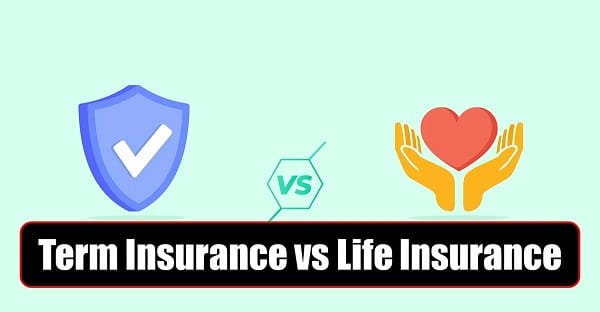
Term Insurance vs Life Insurance: The Main Differences
If you want to buy the right product, it is good to compare term insurance vs life insurance on the same page. Here is a comparison of their features that can have the biggest impact on your finances.
| Feature | Term Life Insurance | Traditional Life Insurance |
| Main Purpose | Pure protection for your family. | Protection plus savings for the future. |
| Cost (Premium) | Very low. Anyone can afford it. | Very high. Can be 10 times costlier. |
| Maturity Benefit | You get nothing back if you survive. | You get a large lump sum back if you survive. |
| Policy Duration | Fixed period (e.g., up to age 60 or 70). | Can last for your whole life (up to age 100). |
| Cover Amount | Gives a massive cover amount for a low price. | Gives a smaller cover amount for a high price. |
Why Term Insurance is So Popular
Almost all financial advisors in India strongly discourage mixing up your insurance with your savings. For instance, if a young individual wants a cover of ₹1 Crore to protect their family, they may only need to pay about ₹1,000 per month for a term life insurance plan. However, if they attempt to purchase a traditional life insurance plan providing the same ₹1 Crore coverage, they could end up paying anywhere between ₹80,000 and ₹1,000,000 every single year!
Such high premiums are beyond the means of most middle-class families. So, often, they settle for a lower traditional plan that only offers ₹5 Lakhs or ₹10 Lakhs of coverage. Unfortunately, in case of a demise of the main breadwinner, that small sum won’t be sufficient to sustain a family for several years.
Term insurance plans offer you a great deal of coverage at a very low cost. You can also invest the substantial amount saved due to lower premium payments into other investment avenues like bank FDs, PPF or mutual funds for wealth accumulation.
Picking the Best Plan for Your Family
The needs of every Indian family are different. Here is a brief cheat sheet that will help you figure out where you stand on the term insurance vs. life insurance spectrum.
Opt for Term Life Insurance in these cases:
- You are the only one earning money in your home.
- Your kids are small, your parents are aged, and your wife/husband is financially dependent on you.
- A part of your financial obligations comprises home, car, education, or personal loans.
- You wish to have the maximum coverage with minimum spending.
Choose Traditional Life Insurance if:
- You often find yourself struggling to save money and would like a very disciplined savings plan that compels you to save regularly
- You need a 100% guaranteed amount of money for a particular purpose, such as a child’s higher education expenses or wedding.
- You wish to pass on a property to your grandchildren even after you have gone through old age.
Conclusion
Helping your family should not feel like a heavy load to you. First, check your monthly income, make a list of your future expenses, and see who depends on you.
Generally, for the day-to-day buyers, the best first step is to simply buy a term life insurance plan. It can protect your family today without causing a major financial problem for you tomorrow.